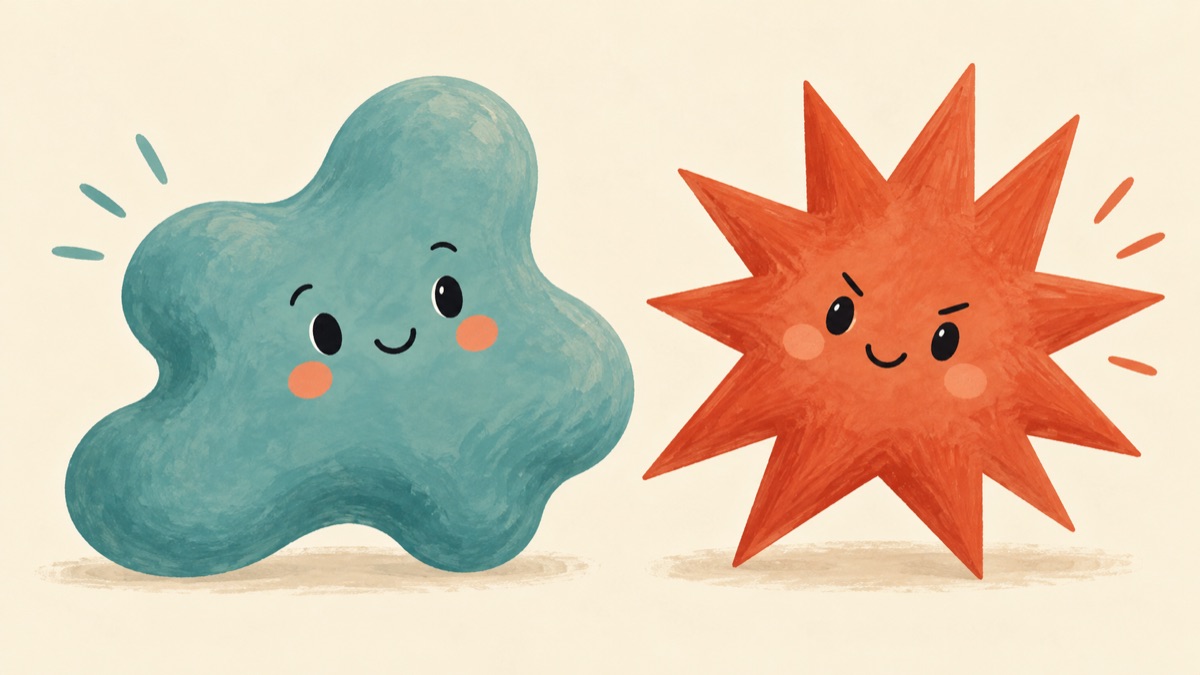
Bouba, Kiki and the Shape of Sounds
It takes ten seconds to test on everyone at the table, and the result is weirdly reliable across the world. It opens up a big question: are words just random labels, or do some sounds carry meaning?
- • The effect is about 100 years old: Georgian psychologist Dimitri Uznadze ran the first experiment in 1924, and in 1929 Wolfgang Köhler used the made-up words 'maluma' for a round shape and 'takete' for a spiky one. The names 'bouba' and 'kiki' come from a 2001 version where about 95% of people matched them the same way.
- • A 2022 study of 917 people speaking 25 languages with 10 writing systems found the effect worked about as well whether or not the letters themselves looked round or spiky, so it is about the sound, not the spelling. A 2013 study even found 4-month-old babies looked longer when sound and shape were 'wrongly' matched.
- • It also works with real names: people tend to match 'Molly' with round shapes and 'Kate' with sharp ones.
Can a made-up word have a shape? Picture two drawings. One is a soft, blobby cloud. The other is a spiky star, all sharp points. One is called bouba. One is called kiki. Which is which?
Decide before you read on.
Got it? Almost everyone says the blob is bouba and the star is kiki. In a famous test in 2001, about 19 out of 20 people did. And it isn't just English speakers. A 2022 study asked over 900 people who speak 25 different languages, written in 10 different writing systems. Same pattern. Even toddlers about two and a half years old do it.
So why? Say them out loud. Bouba. Feel your lips go round and puffy. Kiki. Your mouth stretches tight, and that k makes a sharp little click. Your brain seems to link the shape of the sound with the shape you see. Scientists still argue about exactly why.
Here's the twist. Most words are random. Nothing about the word dog sounds doggy. But some sounds carry a feeling. So when storytellers invent a name for a cuddly monster or a sharp-toothed villain, the sounds can already hint who's who.
It isn't perfect, though. Speakers of a few languages, like Turkish and Mandarin Chinese, matched less clearly. Nobody knows why yet.