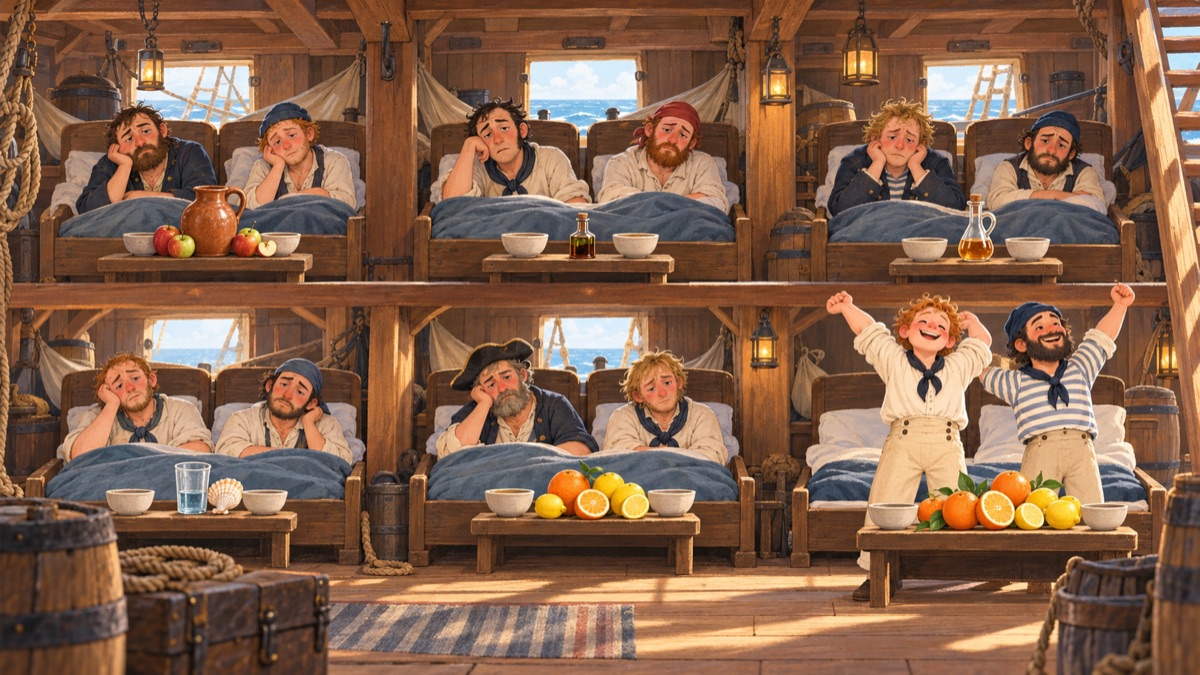
Twelve Sick Sailors and a Fair Test
This is the clearest example of the one rule behind every good experiment: change one thing, keep everything else the same. Kids can use it tomorrow, and the twist shows that even a good result can be ignored or lost.
- • Scurvy was a huge killer at sea: researchers estimate it killed at least 2 million sailors between 1500 and 1800, and on one British ship in the 1740s at least 380 of a crew of 510 died of it.
- • The navy only began handing out lemon juice widely in 1795, after a fleet supplied with it sailed 19 weeks to Madras, now Chennai, without scurvy.
- • Then the cure was partly lost again: the navy switched to cheaper limes with less vitamin C, because people thought the sour acid did the work. A 1918 test found the navy's lime juice had almost no anti-scurvy power.
How would you find out which of six medicines really works?
Long ago, sailors spent months at sea eating dry, salty food. No fresh fruit. After a month or so, many got scurvy. First tired, with sore arms and legs. Then bleeding gums. Without help, it killed them.
In 1747 a ship's doctor called James Lind had 12 sick sailors. He could have guessed. He played fair instead.
He split them into 6 pairs. Everyone ate exactly the same food. Then each pair got one extra. Cider. Vinegar. Seawater, yuck. A spicy paste. And one lucky pair got 2 oranges and a lemon a day.
Why so fussy? If only one thing is different, that one thing must be what made the difference. It's like testing paper planes: same paper, same thrower, change just one fold.
After 6 days the fruit ran out. One fruit sailor was back at work. The other was nearly better.
Did the navy rush out lemons? Nope. Lind tucked his result into a long, muddly book, and he wasn't sure himself.
Nearly 50 years later, the navy finally handed out lemon juice. It worked.
Then they swapped to cheaper limes, sure the sourness did the trick. It didn't. The real hero was vitamin C, and limes had less. Nobody ran a fair test to check.