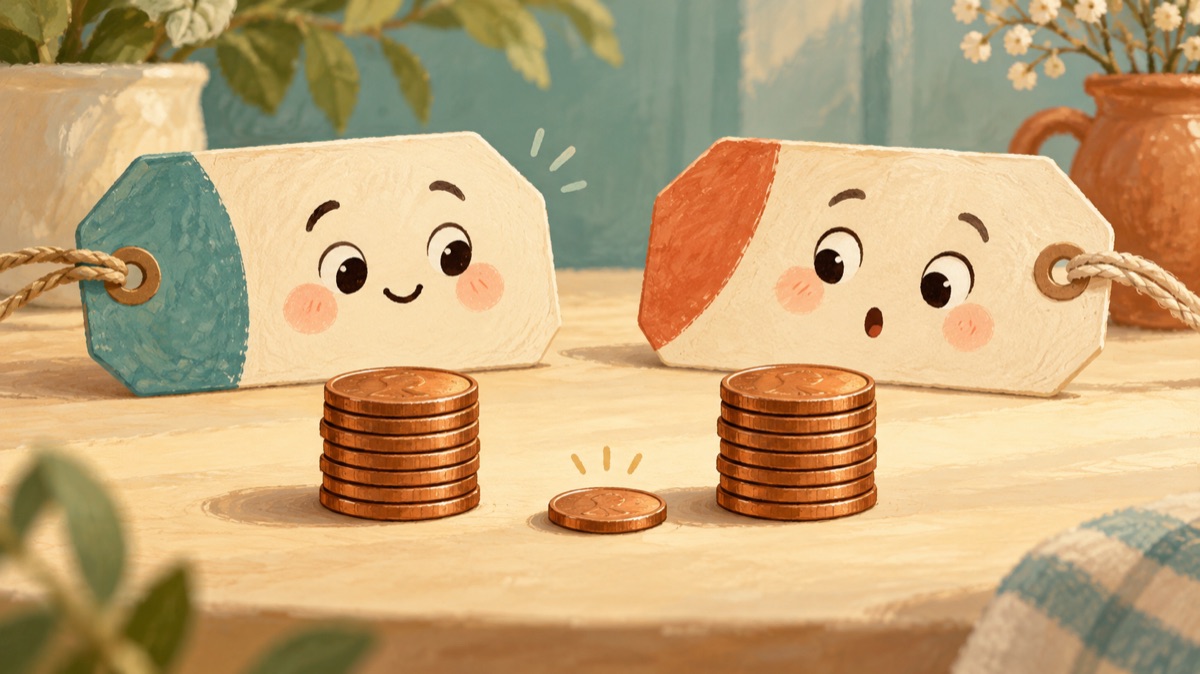
The 1 Cent Brain Trick
Prices ending in .99 are everywhere, and they work because of how we read numbers, not because anyone is bad at sums. Kids who learn the 'left-digit effect' start seeing through it in every shop.
- • Thomas and Morwitz ran five experiments and found the .99 trick works only when the leftmost digit changes: 2.99 versus 3.00 feels different, 2.89 versus 2.90 does not. The closer two prices are, the stronger the effect.
- • In three field experiments with real US shops, Anderson and Simester found prices ending in 9 lifted sales every time, more for new items than familiar ones, and less when 'Sale' signs were up.
- • The bias survives big money: in over 22 million US used-car sales, prices drop suddenly each time the distance reading crosses a round 10,000.
Is 2.99 closer to 2 or to 3?
Be honest. Your brain whispered 2.
Here is what happens. Step one: you read numbers left to right. Step two: your brain grabs the first digit and half-ignores the rest. Step three: so 2.99 gets filed as 'two-something', even though it is just 1 cent off 3.00.
Shops know. In three real experiments with shops in the US, switching prices to end in 9 sold more in all three.
But it is not magic. It worked better on new items than on things the shop had sold for years. It was weaker next to 'Sale' signs. It works best when you have no idea what something should cost.
And it only works when the first digit changes. 2.89 versus 2.90? Your brain shrugs. 2.99 versus 3.00? Different planet.
Think this only fools people over small change? Researchers studied more than 22 million used-car sales in the US. Prices drop suddenly every time the distance counter passes a round 10,000. A car showing 59,999 sells for more than one showing 60,000. Same car, basically. Big money at stake, and grown-up brains still get tricked by one digit.
Next time you see 4.99, say it out loud the honest way: five.