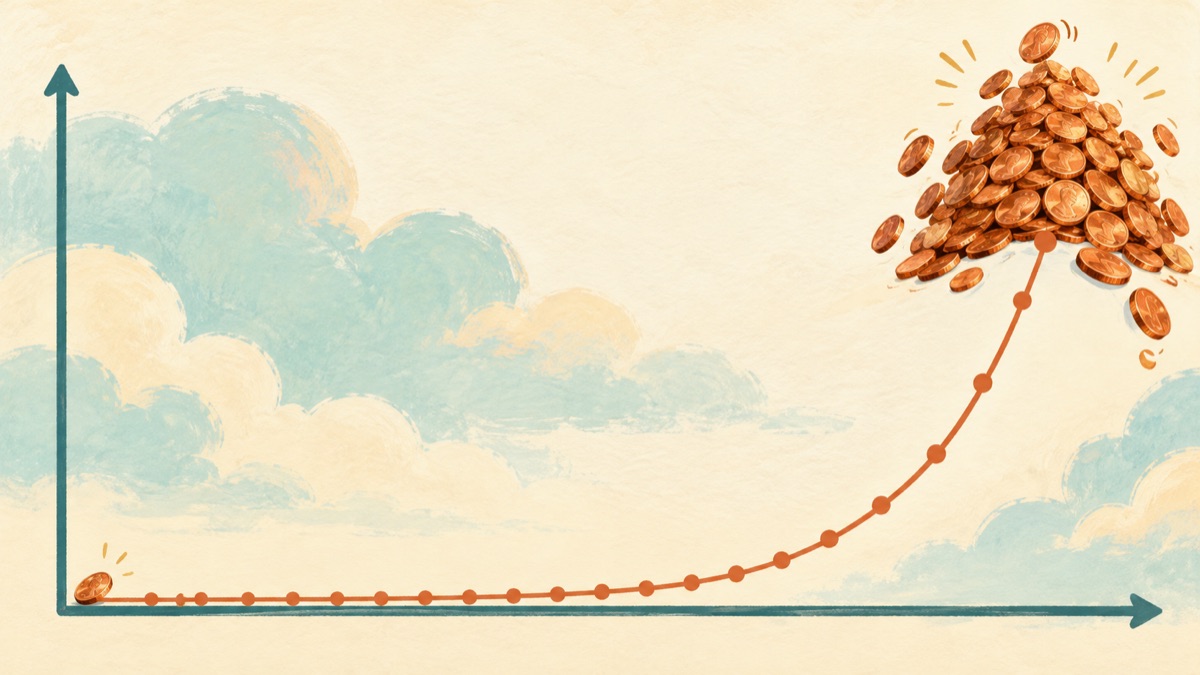
The Cent That Beat a Million
This puzzle makes exponential growth feel real: the doubling cent looks hopeless for weeks, then wins by a mile. It is the same engine behind compound interest on savings, just sped up.
- • Wording trap: by Day 30 the cent has doubled only 29 times, giving $5,368,709.12. Thirty full doublings, the Day 31 value, would be $10,737,418.24, and adding up every daily amount from Day 1 to Day 30 gives $10,737,418.23.
- • Compound interest is 'interest on the interest': 1,000 at 5% earns 50 in year one, then the next year's interest is worked out on 1,050, then on 1,102.50.
- • The Rule of 72: divide 72 by the yearly growth rate to estimate how many years money takes to double, so at 10% a year it doubles in about 7.2 years.
Would you rather have 1 million dollars right now, or 1 cent that doubles every day for 30 days?
Vote. No switching later.
Day 1: 1 cent. Day 7: 64 cents. Not even a snack. The million-dollar voters are smug.
Day 15: you finally pass 100 dollars. Day 20: about 5,000. Still embarrassing.
Then it turns. Day 27: about two-thirds of a million. Still losing. Day 28: about 1.3 million. You win. Day 30: about 5.4 million, more than five times the million.
How? Step one: each day you add a whole copy of yesterday's pile. Step two: so the bigger the pile, the bigger the jump. Step three: the jumps snowball. The last 10 days multiply your Day 20 money by about a thousand.
Here's the part that surprises grown-ups. On Day 29 you have only half your final money. Half of everything arrives on the very last day. Quit one day early and you lose half.
Real savings work the same way, just slower. Put 1,000 in the bank at 5 percent and you earn 50. Next year you earn interest on 1,050, interest on your interest. At 10 percent a year, money doubles in about 7 years.
The catch? You have to sit through the boring part, when your pile looks like nothing.