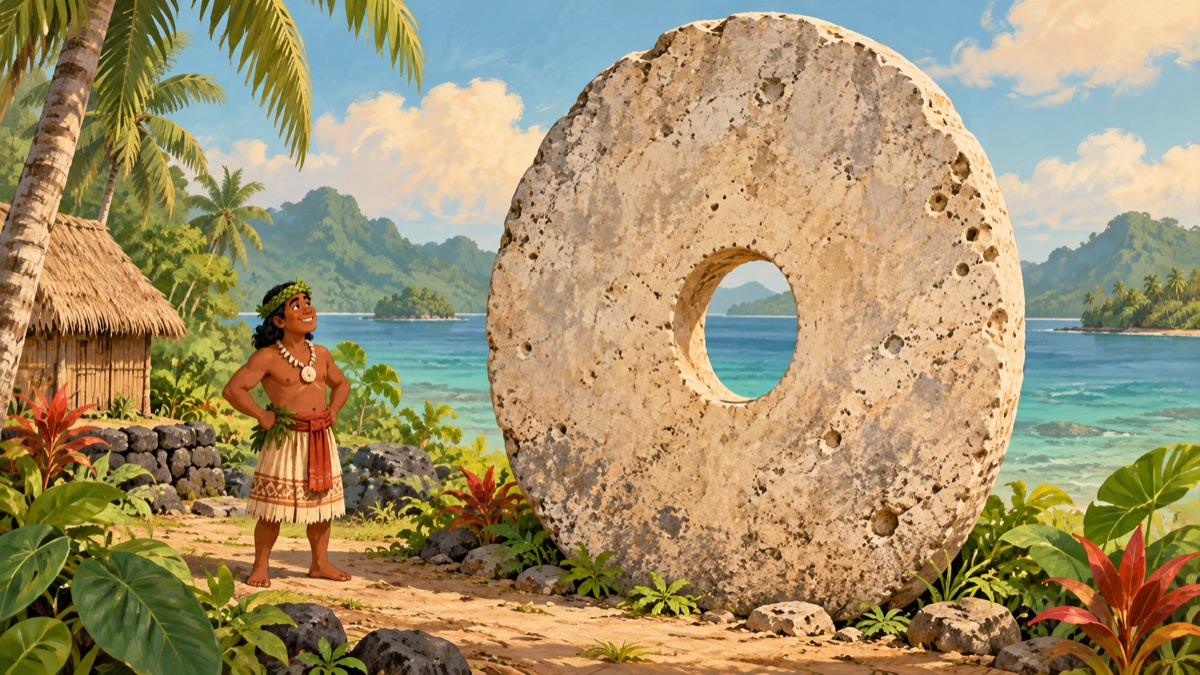
The Money at the Bottom of the Sea
Kids think money is coins and notes. This story shows that money is really a shared agreement, and that the money in your own bank account works more like a giant stone than a coin.
- • In the UK, bank deposits, which are just numbers in bank accounts, make up about 97% of the money people and companies hold; notes and coins are only about 3%.
- • Economist Milton Friedman (1991) compared Yap to a bank vault in New York where gold changes owner between countries without ever leaving the room. A 2022 paper by researcher Jo Lindsay Walton warns that many Western retellings of Yap contain errors and reflect the writers' own arguments, so hold the neat lesson lightly.
- • A stone's value depended on its size, how well it was made and its history, for example whether a famous sailor brought it or people died carrying it.
Could a rock be money, even if it's lying at the bottom of the sea?
On Yap, a group of islands in the Pacific, people used giant stones as money. Round, with a hole in the middle, like a huge doughnut. The biggest one still standing is 3.6 metres across and weighs about 4,000 kilograms. Heavier than a car. Try fitting that in your pocket!
Nobody bought snacks with them. Stones paid for big things, like a wedding gift.
There's no gold or silver on Yap. So people sailed hundreds of kilometres, carved the stones on other islands, and brought them home in small boats. Hard, dangerous work.
Later, iron tools and big ships made stones easy to get. People made more, and bigger ones. But the new stones were worth less! Easy to get means less special.
Now the clever bit. A stone that heavy almost never moved. To pay someone, the whole village just remembered: that stone was hers, now it's his.
Once, a stone sank in a storm. Nobody ever saw it again. Everyone agreed it still counted!
Weird? When a grown-up pays online, no coins move. Numbers just change in two bank computers. Like a stone nobody can see.
So what makes money money? Everybody agreeing that it is.