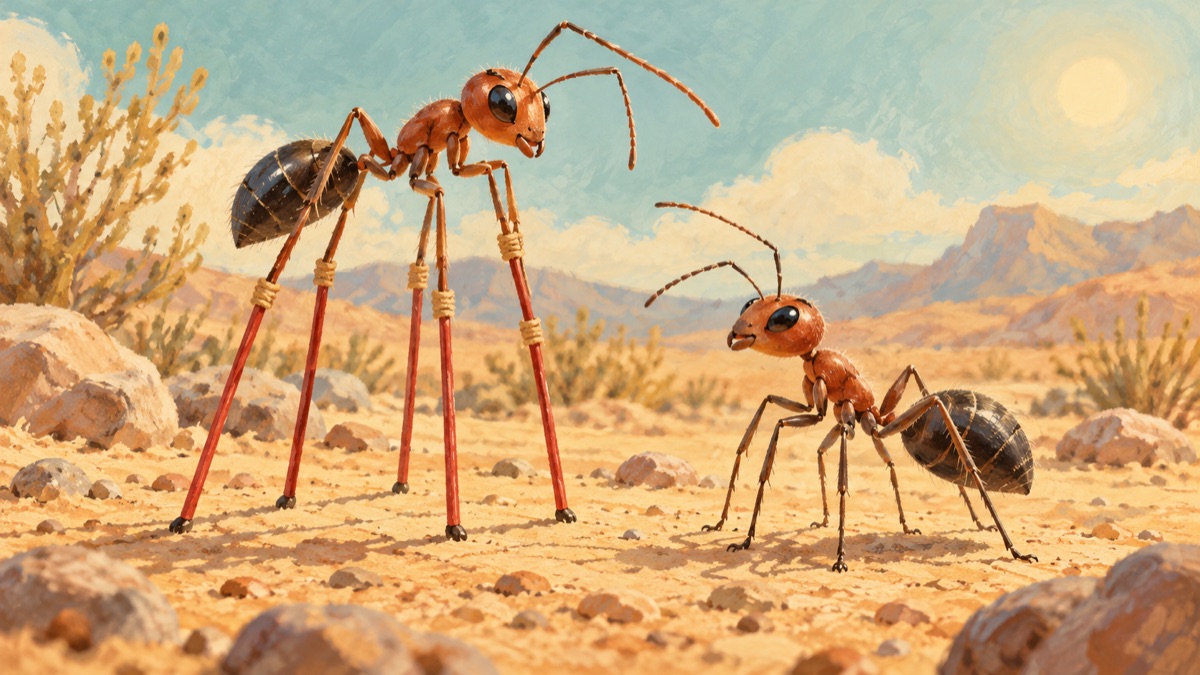
Ants on Stilts
It is one of the neatest experiments in biology: a guess, a simple test, and a result your kids can predict before you read it.
- • Getting home takes two pieces of information: direction, which the ant reads from the sun and the pattern of light in the sky, and distance, which it gets by counting steps, like a pedometer.
- • The study, by Matthias Wittlinger, Rüdiger Wehner and Harald Wolf, was published in the journal Science in 2006 and was the first convincing evidence of a built-in step counter in any animal.
- • Life is tough for these ants: about 15% of foragers die each day, so a quick, straight trip home really matters.
Close your eyes, take 10 steps away from the table, then turn and walk back. How did you know when to stop?
Now meet a desert ant in the Sahara, one of the hottest places on Earth. It zigzags over flat, empty sand looking for food, often more than 100 metres from home. Then it grabs a crumb and runs straight home.
How? It needs two answers: which way, and how far. For which way, it reads the sun like a compass. For how far, scientists had a guess. It counts its steps.
So three scientists tested it. They trained ants to walk a 10-metre track from nest to food. Then some ants got tiny surgery. Some got stilts: a stiff pig hair glued to each leg. Others got their legs trimmed short.
Here's the trick. Each ant still counts the same number of steps. Short legs make short steps, so that count covers less ground. Those ants started hunting for home after about 6 metres.
Stilts make giant steps, so the same count covers more ground. Those ants marched right past their front door, to about 15 metres.
The ants weren't measuring the sand. They were counting themselves.
And the best bit? After a few days on their new legs, their step counters reset, and they found home again.