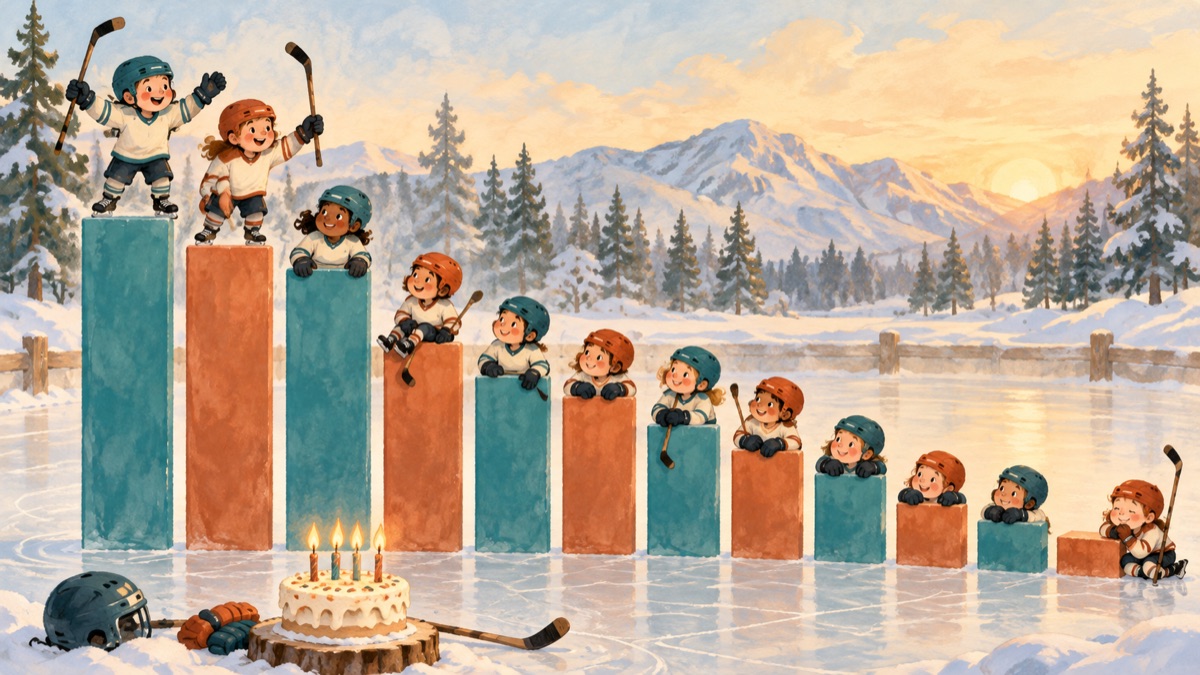
The Birthday Draft
A tiny accident of the calendar shapes who gets picked in youth sport, and the twist at the top flips the story: the kids who were overlooked can end up the best.
- • The relative age effect was first measured in hockey in 1985 by Roger Barnsley and colleagues; a 2009 review of 38 studies across 14 sports and 16 countries found it almost everywhere, though usually small.
- • Malcolm Gladwell's book Outliers made the effect famous, but students at BYU who checked the 2010 Canadian Olympic hockey team found the opposite pattern, which led to the NHL study.
- • In the NHL from 2008 to 2016, top-10% scorers born October to December scored about 9 more points a season than January to March births, and top-10% earners born late earned 51% more.
Who here is one of the oldest in their class? Who is one of the youngest? Does it matter?
Setup: nothing but everyone's birth month. About 5 minutes.
Rules: 1. Everyone says their birth month. 2. Line up from January to December. Pretend the cut-off is 1 January, like many youth sports. 3. A coach is picking the five best 10 year olds for a top team. Vote: which end of the line do most of them come from?
The reveal. Picture two 10 year olds in the same group. One born in January, one in December. The January kid has had almost a whole extra year to grow. Bigger. Faster. Stronger. Step one: the coach picks the bigger kid, not the more talented one. Step two: picked kids get more games and better coaching. Step three: they really do get better. A birthday gap becomes a skill gap.
Researchers first spotted this in hockey in 1985. A review of 38 studies across 16 countries found it nearly everywhere: small, but strongest for boys aged 15 to 18 at the top levels.
Now the twist. Look at the NHL, North America's top hockey league. Players born October to December score more and earn more. Among the very best paid, late-borns get about one and a half times the pay.
Why? Maybe the underdog effect: small kids learn to work harder. Or a filter: only late-borns with extra talent survive. Early-borns still fill more of the league. But the late-borns who make it are often the best.