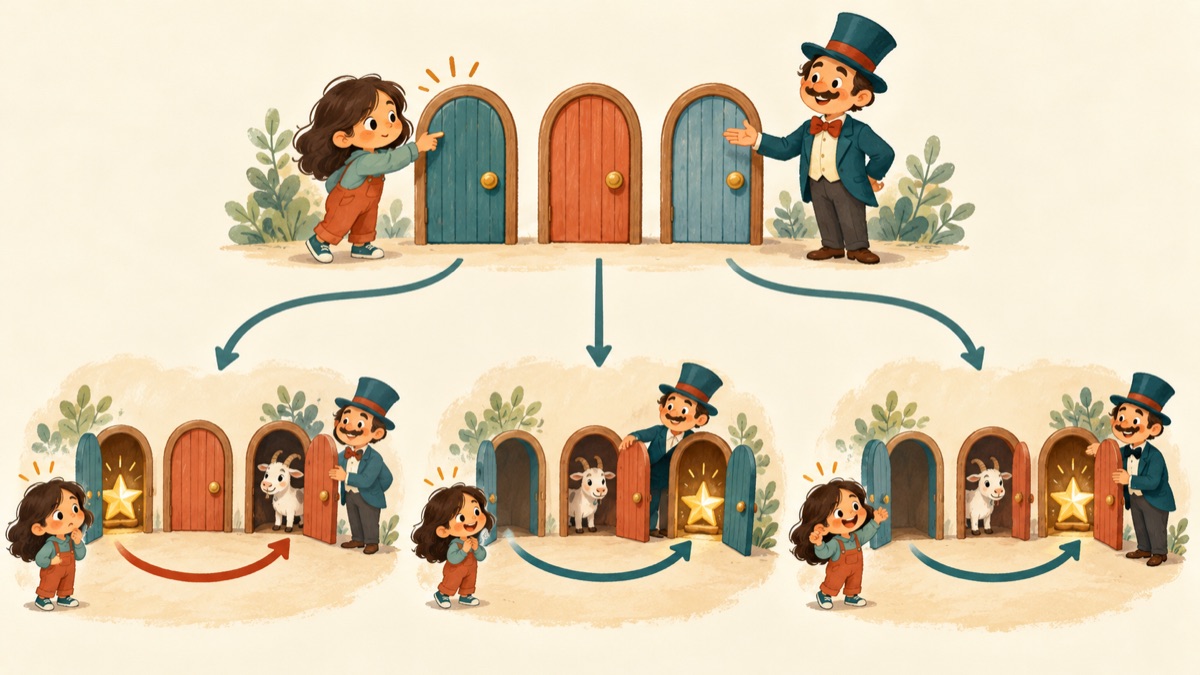
Stick or Switch?
A three-cup game with an answer that fooled about 1,000 PhDs, and that pigeons learned faster than people.
- • When a magazine columnist said in 1990 that switching wins, she got about 10,000 letters, most saying she was wrong; close to 1,000 were signed by people with PhDs.
- • The real game-show host tested it at his dining table: sticking won 4 of 10 rounds, switching won 8 of 10.
- • In a 2010 study, pigeons learned to switch nearly every time, while humans given the same training still didn't switch consistently.
A game-show host opens a losing door and lets you swap. Should you? Most people say it doesn't matter. Most people are wrong.
SETUP: Three cups, one small sweet, paper for scores. About 5 minutes.
RULES: 1. The Host hides the sweet under a cup while the Player looks away. 2. The Player points at one cup. 3. The Host, who knows where the sweet is, always lifts a different, empty cup. 4. The Player sticks or switches to the last cup. 5. Play 10 rounds sticking, then 10 switching. Pool everyone's scores: 10 rounds is a small sample, and luck can wobble it.
THE REVEAL: Switching wins 2 times in 3. Sticking, only 1 in 3.
Why? Your first pick is right just 1 time in 3. The Host always has an empty cup to lift, so lifting one tells you nothing about your cup. Still not convinced? Imagine 100 cups. You pick one. The Host lifts 98 empty ones. Would you really stay with your lucky guess, or grab the one cup he carefully skipped?
When a columnist explained this in 1990, about 10,000 letters poured in, most saying she was wrong. Close to 1,000 came from people with PhDs. One professor wrote, "You blew it!" He was the one who blew it.
The real host tried it at his dining table: sticking won 4 of 10, switching 8.
The embarrassing part? Pigeons learned to switch nearly every time. People mostly kept sticking, feeling they "owned" their first pick.