A Family of Bad Guessers
A jar of beans shows an idea used everywhere from forecasting to quiz shows: average many independent guesses and the errors cancel out. The catch is the word 'independent'.
- • In 1907 Francis Galton studied 787 guesses of an ox's butchered weight at an English fair; the middle guess was off by under 1%, and a later recheck found the average almost exactly right, even though the crowd included expert butchers and farmers.
- • A 2011 experiment with 144 people found that seeing others' guesses made answers bunch together without getting more accurate, while making people more confident.
- • Averaging two separate guesses from the same person, even 3 weeks apart, tends to beat a single guess: the 'crowd within', confirmed in a pre-registered replication.
Can a whole family of bad guessers make one great guess? Grab a jar and find out.
SETUP: A jar or bag of dried beans or sweets that one person has secretly counted, plus paper and pens. About 5 minutes.
RULES: 1. Everyone stares at the jar for 20 seconds. No touching. 2. Write your guess in secret. No talking, no peeking. 3. Reveal the guesses and work out the family average. 4. Reveal the real count. Who was closest? Did the average beat most of you? 5. Round two, new jar: this time talk it over first, then guess.
Warning: four or five guessers is a tiny crowd, so luck matters. If the average flops, that's part of the lesson.
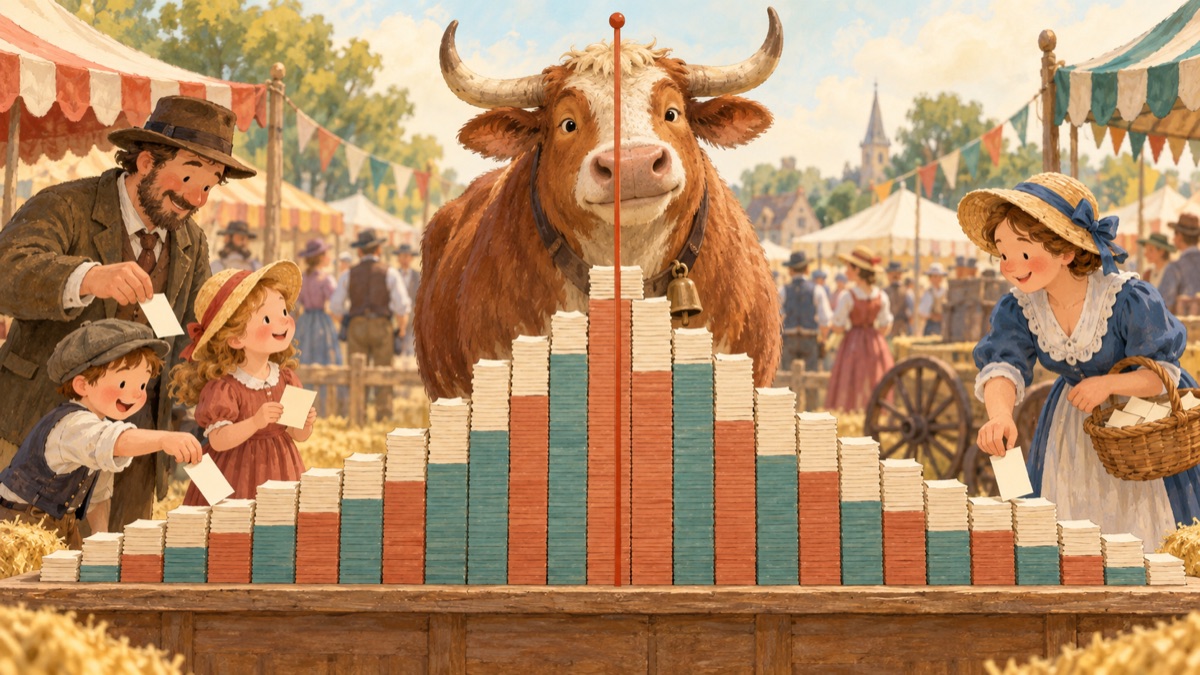
THE REVEAL: In 1907, a scientist named Francis Galton visited a country fair in England. There, 787 people paid to guess how much an ox's meat would weigh. The real answer was about 543 kg. The middle guess? About 547 kg. Off by just 4 kg, under 1%! The crowd included expert butchers, yet it beat most individual guessers.
How? Step zero: nobody peeks. Step one: every guess is the truth plus a mistake. Step two: some guess too high, some too low. Step three: average them and the highs and lows cancel out.
Now the irony. In a 2011 experiment with 144 people, seeing each other's guesses made answers bunch together. Not more accurate. Just more confident!
So, how did round two go?