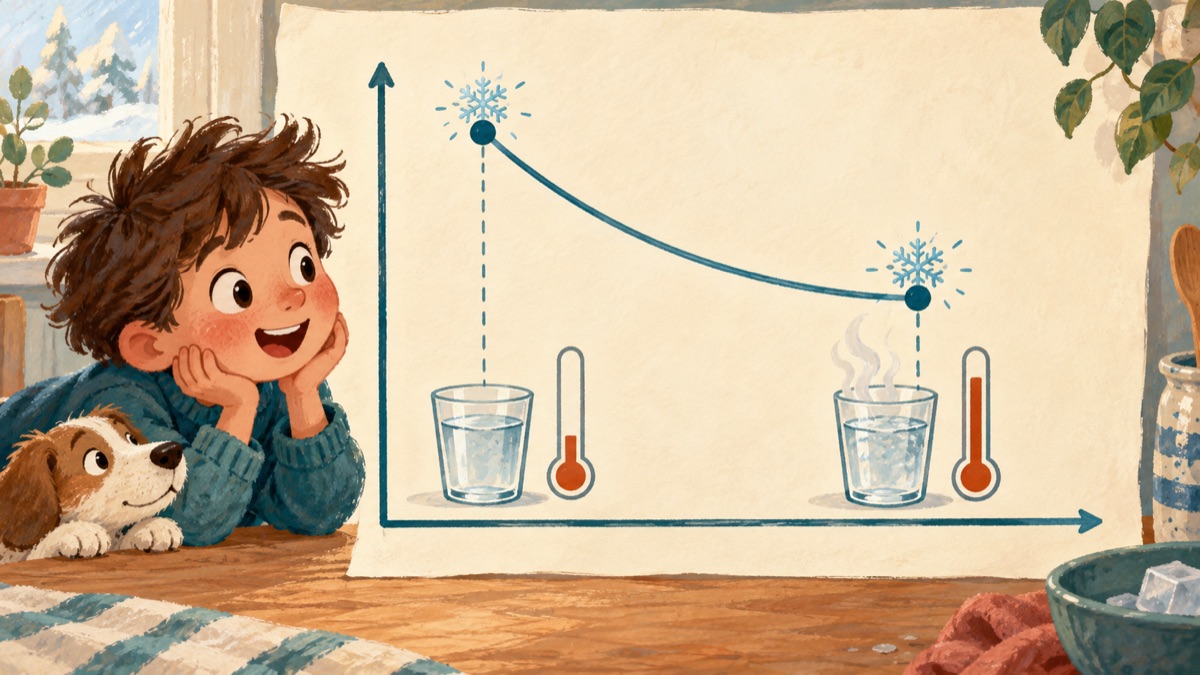
The Boy Who Wouldn't Stop Asking
Almost every adult 'knows' cold water freezes first, and it's not that simple. It's also a great story about a teenager who kept asking until a scientist tested it.
- • The idea is ancient: around 2,300 years ago Aristotle wrote that warmed water freezes more quickly, and Francis Bacon and René Descartes said similar things in the 1600s.
- • In 2012 the Royal Society of Chemistry ran a competition for the best explanation and got over 22,000 entries. The winner, Nikola Bregović, was praised for careful experiments, but nobody solved it.
- • The 2016 study that found no effect timed water cooling to 0 °C, not turning fully solid, which is exactly why definitions matter. Physicists have since found related Mpemba effects in tiny particle and even quantum systems.
Hot cup, cold cup, both into the freezer. Which turns to ice first? Bet now.
Cold water has less cooling to do, right? Meet Erasto Mpemba, a teenager in Tanganyika, now Tanzania. In 1963, in cookery class, he noticed his hot ice-cream mix froze before a cold one. Nobody believed him.
He kept asking. When a physics lecturer, Dr Denis Osborne, visited his school, Mpemba asked why water starting at 100 degrees froze before water at 35. Osborne thought he was wrong, tested it in his lab, and got the same result. They published together in 1969.
How could hot water win? Scientists have suspects. One: hot water steams some of itself away, so less is left to freeze. Two: cold water can sink below 0 degrees and still refuse to become ice. Three: a hot cup melts the frost under it, so it sits snug against the freezing floor.
None is proven. Sixty years on, experts still argue. In 2016 one team timed water cooling to 0 degrees and found no real effect. In 2024, another found hot drops froze faster.
Both can be honest. Does 'frozen' mean the first ice crystal, or solid all the way through? Even the cup or the thermometer's spot can flip it.
So who wins? It depends where you draw the finish line.